Predictions & Data for this entry
| Model: std | climate: Cfb, Cfc | migrate: | phylum: |
| COMPLETE = 2.5 | ecozone: TA | food: biCi | class: |
| MRE = 0.035 | habitat: 0iTa, 0iTg | gender: Dg | order: |
| SMSE = 0.003 | embryo: Tt | reprod: O | family: |
Zero-variate data
| Data | Observed | Predicted | (RE) | Unit | Description | Reference |
|---|---|---|---|---|---|---|
| ab | 71 | 71.01 | (0.0001671) | d | age at birth | CaleSchw2004 |
| ap | 375.5 | 396.5 | (0.05606) | d | age at puberty | CaleSchw2004 |
| am | 4380 | 4380 | (4.51e-06) | d | life span | Schw2016 |
| Lb | 3.845 | 3.699 | (0.038) | cm | snout to vent length at birth | CaleSchw2004 |
| Lp | 9 | 8.212 | (0.08757) | cm | snout to vent length at puberty | CaleSchw2004 |
| Li | 13 | 13.01 | (0.0008723) | cm | ultimate snout to vent length | Schw2016 |
| Wwb | 0.97 | 0.9976 | (0.02846) | g | wet weight at birth | CaleSchw2004 |
| Wwp | 11 | 10.92 | (0.007638) | g | wet weight at puberty | CaleSchw2004 |
| Wwi | 41.8 | 43.42 | (0.03879) | g | ultimate wet weight | Schw2016 |
| Ri | 0.0137 | 0.01372 | (0.001869) | #/d | maximum reprod rate | CaleSchw2004 |
Uni- and bivariate data
| Data | Figure | Independent variable | Dependent variable | (RE) | Reference |
|---|---|---|---|---|---|
| LW | 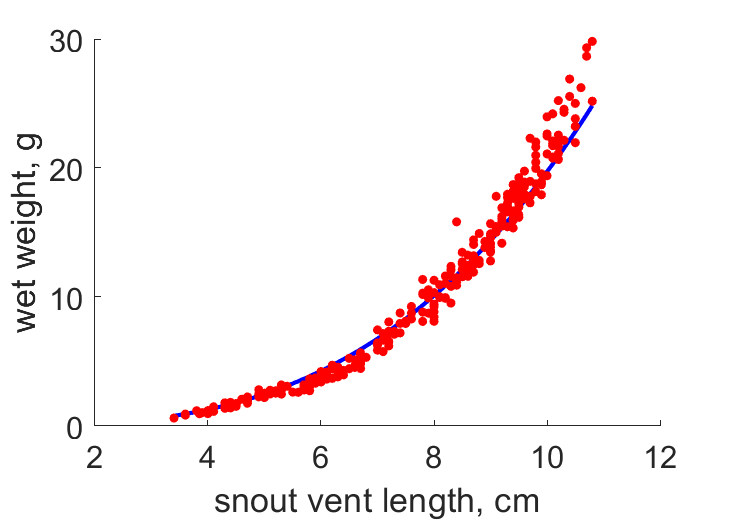 | snout vent length | wet weight | (0.07794) | CaleSchw2004 |
| tL | 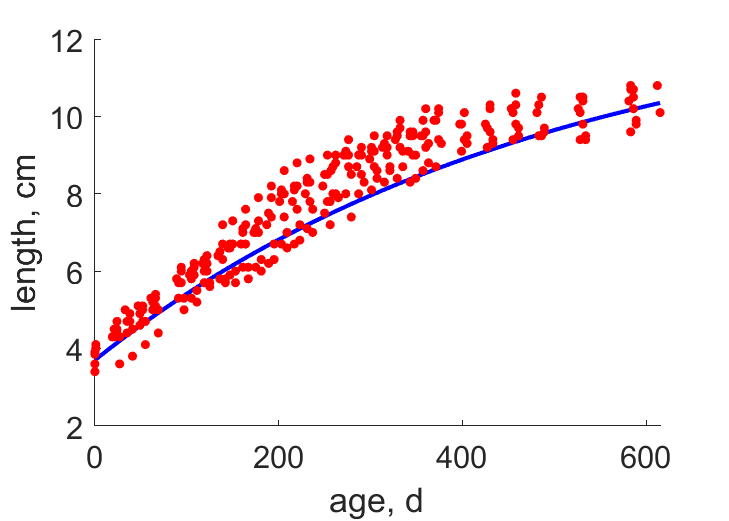 | age | length | (0.0817) | CaleSchw2004 |
Pseudo-data at Tref = 20°C
| Data | Generalised animal | Eulamprus quoyii | Unit | Description |
|---|---|---|---|---|
| v | 0.02 | 0.02833 | cm/d | energy conductance |
| kap | 0.8 | 0.8521 | - | allocation fraction to soma |
| kap_R | 0.95 | 0.95 | - | reproduction efficiency |
| p_M | 18 | 50.3 | J/d.cm^3 | vol-spec som maint |
| k_J | 0.002 | 0.002 | 1/d | maturity maint rate coefficient |
| kap_G | 0.8 | 0.8018 | - | growth efficiency |
Discussion
- See Schwarzkopf, Caley and Kearney 2016 for further details
- These parameters are for a Sydney (temperate) population - a population from Townsville (tropical) was also considered
- The effect of cold rearing conditions on growth was also explored and it was concluded that thermal acclimation in the embryo results in altered thermal response as a hatching
- mod_3: inclusion of t-L and t-Ww data and subsequent re-estimation
Bibliography