Predictions & Data for this entry
| Model: std | climate: Cfa, Dfa | migrate: Mp | phylum: |
| COMPLETE = 2.4 | ecozone: THn | food: biD | class: |
| MRE = 0.027 | habitat: 0iFc | gender: D | order: |
| SMSE = 0.002 | embryo: Ft | reprod: Os | family: |
Zero-variate data
| Data | Observed | Predicted | (RE) | Unit | Description | Reference |
|---|---|---|---|---|---|---|
| am | 2190 | 2197 | (0.003314) | d | life span | Wiki |
| Lp | 10.5 | 10.52 | (0.002012) | cm | total length at puberty | fishbase |
| Li | 20 | 19.6 | (0.01998) | cm | ultimate total length | fishbase |
| Wwb | 0.00041 | 0.0004113 | (0.0032) | g | wet weight at birth | msstate |
| Wwp | 2.155 | 2.161 | (0.00301) | g | wet weight at puberty | fishbase |
| Wwi | 14 | 13.98 | (0.001755) | g | ultimate wet weight | fishbase |
| NR | 1700 | 1799 | (0.05824) | # | eggs at the end of life | Walk2007 |
Uni- and bivariate data
| Data | Figure | Independent variable | Dependent variable | (RE) | Reference |
|---|---|---|---|---|---|
| tL | 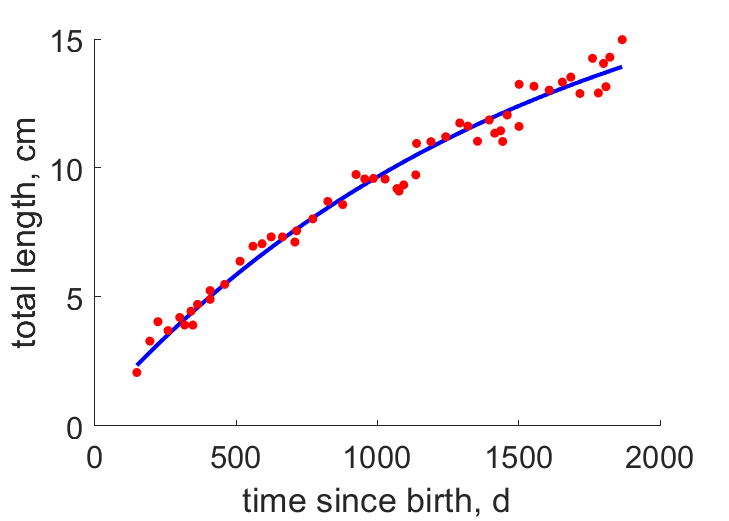 | time since birth | total length | (0.04537) | BeamAust1985 |
Pseudo-data at Tref = 20°C
| Data | Generalised animal | Ichthyomyzon greeleyi | Unit | Description |
|---|---|---|---|---|
| v | 0.02 | 0.0182 | cm/d | energy conductance |
| kap | 0.8 | 0.9095 | - | allocation fraction to soma |
| kap_R | 0.95 | 0.95 | - | reproduction efficiency |
| p_M | 18 | 18.02 | J/d.cm^3 | vol-spec som maint |
| k_J | 0.002 | 0.002 | 1/d | maturity maint rate coefficient |
| kap_G | 0.8 | 0.7997 | - | growth efficiency |
Discussion
- assumption: Ww_i excludes eggs
Facts
- spawns once at end of life; no feeding as adult, no parasitic stage (Ref: Wiki)
- length-weight: Ww in g = 10^(-2.632+2.904*log10(TL in cm)) (Ref: BeamAust1985)
- I. gagei: Ammocoetes do not have a predetermined sex; instead, they all rapidly produce eggs until about 17 months of age. Sex is determined by environmental factors including stream temperature, population density, average growth rate, and pH. Males then re-absorb the eggs, though it is not uncommon for male ammocoetes to still have eggs in their testes. (Ref: msstate)
Bibliography