Predictions & Data for this entry
| Model: std | climate: BSh | migrate: TT | phylum: |
| COMPLETE = 2.5 | ecozone: THp | food: biCi | class: |
| MRE = 0.074 | habitat: 0jFp, jiTh, jiFm | gender: Dg | order: |
| SMSE = 0.014 | embryo: Fh | reprod: O | family: |
Zero-variate data
| Data | Observed | Predicted | (RE) | Unit | Description | Reference |
|---|---|---|---|---|---|---|
| ab | 28 | 26.83 | (0.04175) | d | age at birth | SharVais2014 |
| tj | 126 | 127.6 | (0.01287) | d | time since birth at metamorphosis | VaisShar2015 |
| tp | 1095 | 1065 | (0.02714) | d | time since birth at puberty | SharVais2014 |
| am | 5110 | 5105 | (0.0009567) | d | life span | guess |
| Lb | 1.494 | 1.449 | (0.03011) | cm | length at birth | SharVais2014 |
| Lj | 3.4 | 2.64 | (0.2235) | cm | length at metamorphosis | VaisShar2015 |
| Li | 9 | 8.529 | (0.0523) | cm | ultimate SVL | guess |
| Wwj | 1.5 | 1.522 | (0.01456) | g | wet weight at metamorphosis | VaisShar2015 |
| Ri | 0.2959 | 0.2847 | (0.03783) | #/d | maximum reprod rate | ShariAssa2005 |
Uni- and bivariate data
| Data | Figure | Independent variable | Dependent variable | (RE) | Reference |
|---|---|---|---|---|---|
| tL_f1 | 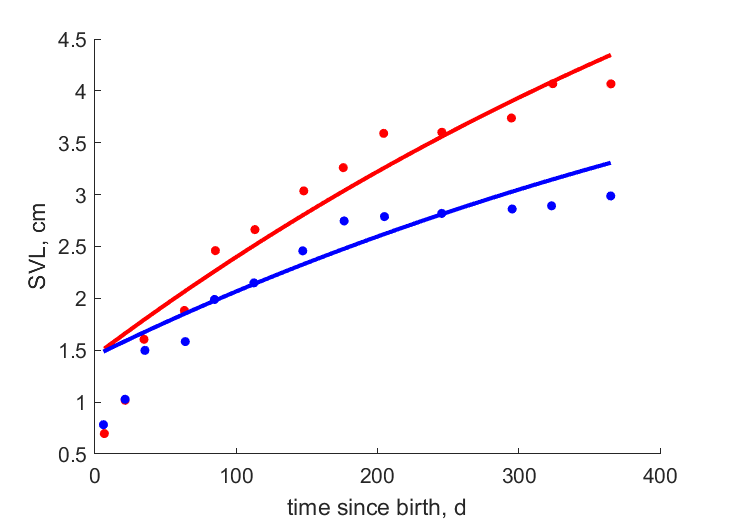 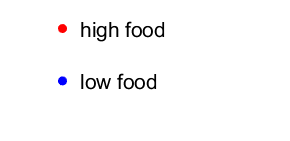 | time since birth | SVL | (0.09724) | VaisShar2016 |
| tL_f2 | | time since birth | SVL | (0.1069) | VaisShar2016 |
| tL | 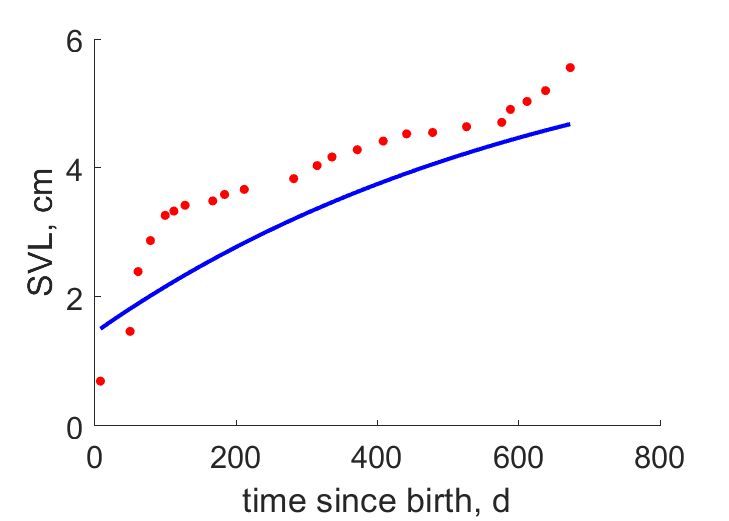 | time since birth | SVL | (0.1823) | VaisShar2015 |
| tWw | 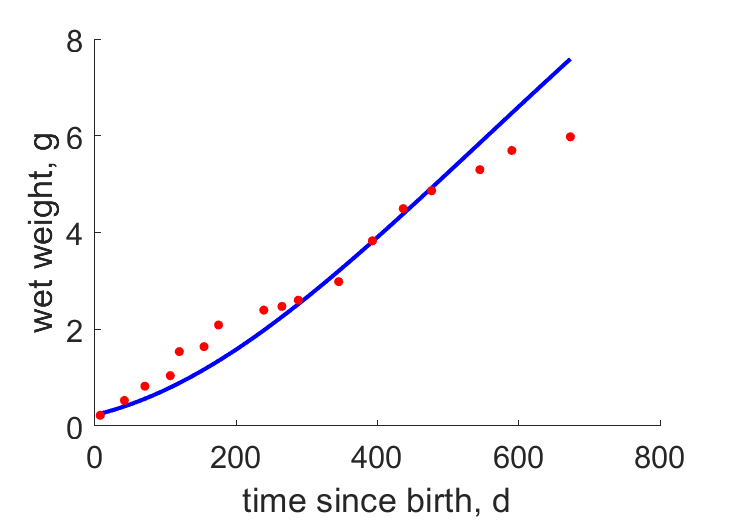 | time since birth | wet weight | (0.1359) | VaisShar2015 |
Pseudo-data at Tref = 20°C
| Data | Generalised animal | Neurergus microspilotus | Unit | Description |
|---|---|---|---|---|
| v | 0.02 | 0.0855 | cm/d | energy conductance |
| kap | 0.8 | 0.4833 | - | allocation fraction to soma |
| kap_R | 0.95 | 0.95 | - | reproduction efficiency |
| p_M | 18 | 67.66 | J/d.cm^3 | vol-spec som maint |
| k_J | 0.002 | 0.002 | 1/d | maturity maint rate coefficient |
| kap_G | 0.8 | 0.8018 | - | growth efficiency |
Discussion
- A lot of the data are from ambient temperatures which depend on the season. We use a standard temp of 15 deg C
- I tried to use two shape coeffients (one pre and one post metamorphosis) but this did not improve the fit.
Facts
- Metamorphosed juveniles begin to stay more in the terrestrial component of their habitat at a body length of 70.13 to 78.09 mm. (Ref: SharVais2014)
- Larval period: hatching to the loss of branchia and closure of branchia slit (Ref: VaisShar2015)
Bibliography