Predictions & Data for this entry
| Model: hax | climate: C, D | migrate: | phylum: |
| COMPLETE = 2.5 | ecozone: TH | food: beTii, eiHe | class: |
| MRE = 0.159 | habitat: 0iTh, 0iTf, 0iTi, 0iTs, 0iTg | gender: D | order: |
| SMSE = 0.068 | embryo: Ta | reprod: O | family: |
Zero-variate data
| Data | Observed | Predicted | (RE) | Unit | Description | Reference |
|---|---|---|---|---|---|---|
| ab | 3.5 | 3.389 | (0.03177) | d | age at birth | MuraLann2004 |
| aj | 7.18 | 5.71 | (0.2048) | d | age at mummification | FuenPowe1996, FuenNiem1998 |
| te | 4.55 | 5.038 | (0.1072) | d | time from mummy to emergence | FuenPowe1996, FuenNiem1998 |
| ae | 43.9 | 40.74 | (0.07209) | d | age at emergence | LegrVern2004 |
| Wdj | 0.00016 | 0.0001169 | (0.2694) | g | dry mass of mummy | LegrVern2004 |
| Wwj | 0.00042 | 0.0006876 | (0.6372) | g | fresh mass of mummy | LegrVern2004 |
| Wwe | 0.00022 | 0.0004218 | (0.9174) | g | female wet weight at emergence | LannWard2011 |
| Ww0 | 2.03e-08 | 1.985e-08 | (0.02218) | g | wet weight of an egg | LannViss2012 |
| Wdj2 | 0.000118 | 0.0001169 | (0.009381) | g | dry mass of mummy | LannViss2012 |
| Wde | 0.0001805 | 7.171e-05 | (0.6027) | g | female dry weight at emergence | LannViss2012 |
| JCe | 0.41 | 0.4081 | (0.004523) | muL CO2 /h | mean basal metabolic rate | LannViss2012 |
| Ni | 392.2 | 387.3 | (0.01258) | # | total number of deposited eggs | ShirCart1983 |
| Nih | 256.6 | 259.2 | (0.01033) | # | total number of hatched eggs | ShirCart1983 |
| am | 13.1 | 13.09 | (0.0006156) | d | life span as imago | ShirCart1983 |
| Le | 0.211 | 0.2108 | (0.0007786) | cm | female length at emergence | CoheJons2005 |
| N24h | 26.92 | 26.98 | (0.00238) | # | aphids parasitized in 24 h | Baye2024 |
Uni- and bivariate data
| Data | Figure | Independent variable | Dependent variable | (RE) | Reference |
|---|---|---|---|---|---|
| Taj | 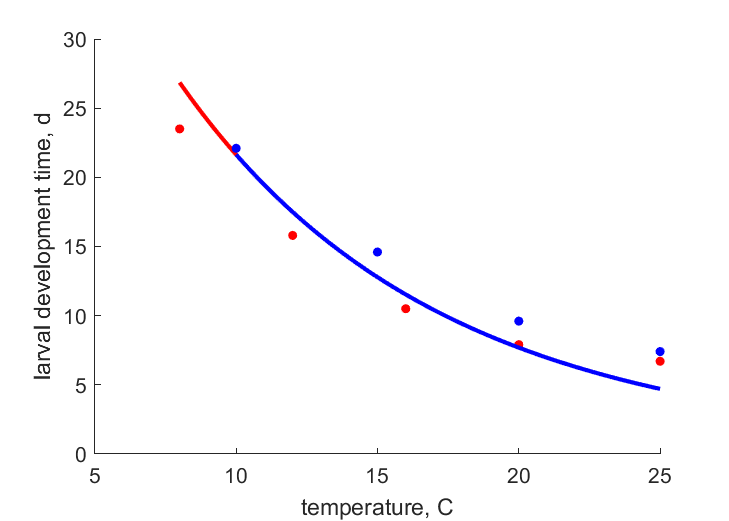  | temperature | larval development time | (0.1288) | Sigs2000 |
| Taj2 | | temperature | larval development time | (0.1284) | LannWard2011 |
| Tte | 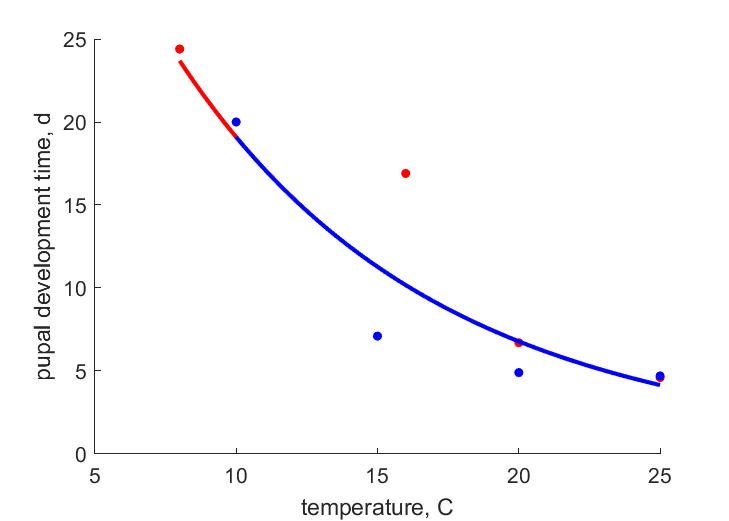  | temperature | pupal development time | (0.1515) | Sigs2000 |
| Tte2 | | temperature | pupal development time | (0.2048) | LannWard2011 |
| TN5h | 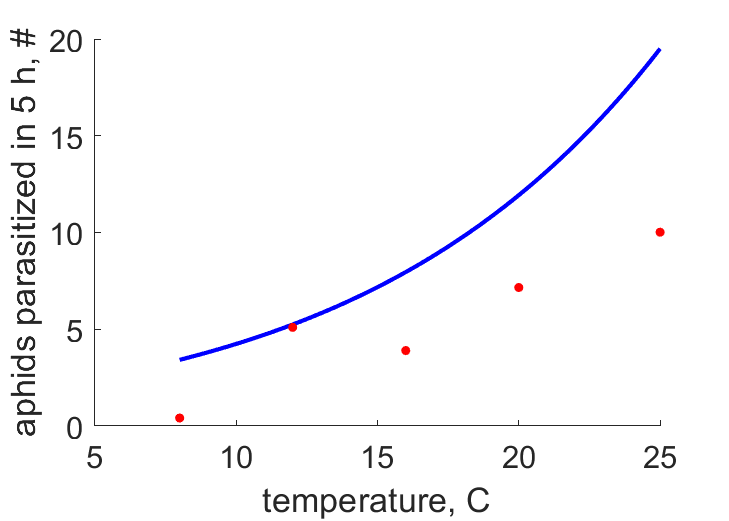 | temperature | aphids parasitized in 5 h | (4.044) | Sigs2000 |
| XN24h | 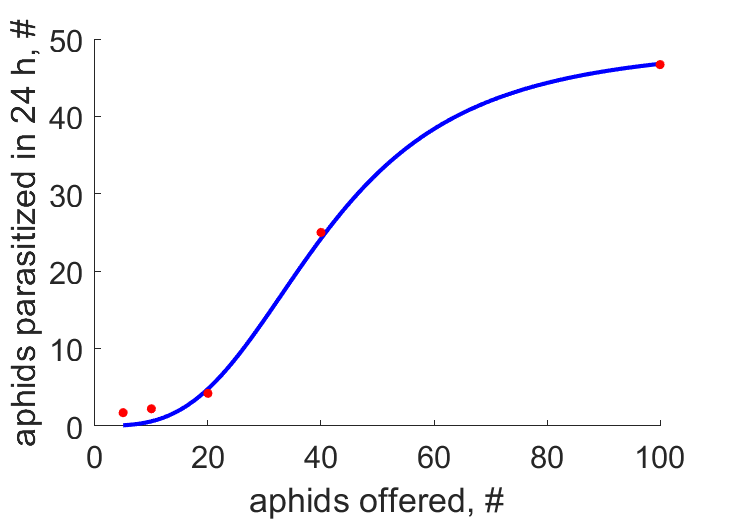 | aphids offered | aphids parasitized in 24 h | (0.05922) | ShirCart1983 |
| tN | 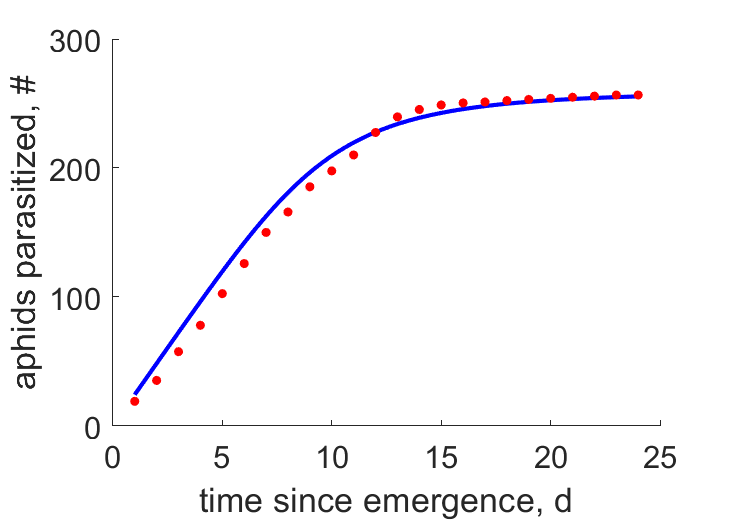 | time since emergence | aphids parasitized | (0.03998) | ShirCart1983 |
| tWw | 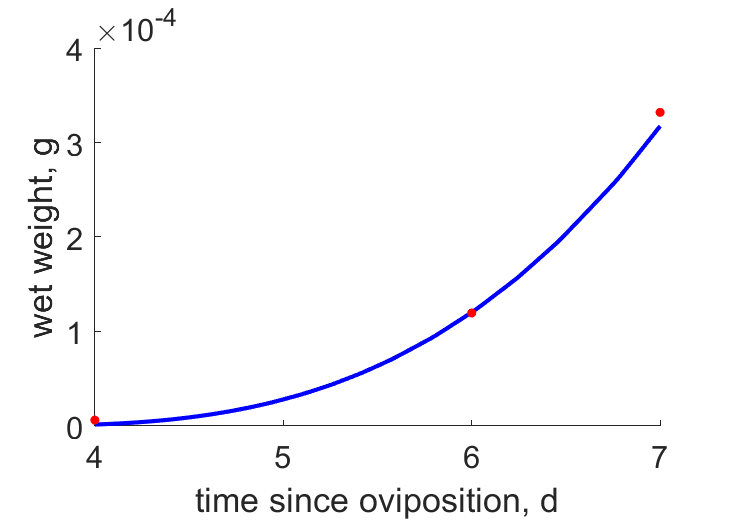 | time since oviposition | wet weight | (0.04364) | MuraLann2004 |
Pseudo-data at Tref = 20°C
| Data | Generalised animal | Aphidius rhopalosiphi | Unit | Description |
|---|---|---|---|---|
| v | 0.02 | 0.01552 | cm/d | energy conductance |
| p_M | 18 | 748.4 | J/d.cm^3 | vol-spec som maint |
| k_J | 0.002 | 0.002 | 1/d | maturity maint rate coefficient |
| k | 0.3 | 0.01176 | - | maintenance ratio |
| kap | 0.8 | 0.957 | - | allocation fraction to soma |
| kap_G | 0.8 | 0.8083 | - | growth efficiency |
| kap_R | 0.95 | 0.95 | - | reproduction efficiency |
| s_s | 0.01 | 1.509e-09 | - | supply stress |
Discussion
- E_Hb is assumed when cellular trophamnion disappears and teratocytes are released into host
- Different f values may be needed to account for different food qualities of different host aphids
- Mummy is treated like pupa in other insects
- Weight of the mummy is entirely attributed to the wasp (weight of the cocoon shell is neglected)
- Assimilation by imago is assumed to cover maintenance costs
- No investment in reproduction buffer after emergence
- As a consequence, the scaled reserve density remains constant at e_e
- Parasitization over time was modeled using a linear phase followed by a decline phase
Facts
- A. rhopalosiphi is a koinobiont; host aphids continue to move and grow for multiple days after parasitization (Ref: LannViss2012)
- A. rhopalosiphi develops through three larval stages inside the host aphid (Ref: MuraLann2004)
- Later, the aphid turns into an immobile mummy containing the nymphal parasitoid (Ref: LannViss2012)
- After emergence, Aphidius parasitoids feed on sugar sources like nectar and honeydew (Ref: LuquPena2021)
- The wasp imagos are not able to synthesize lipids (Ref: LannViss2012)
Acknowledgment
- The creation of this entry was financially supported by Bayer AG
Bibliography